A Ghost of the Meadow
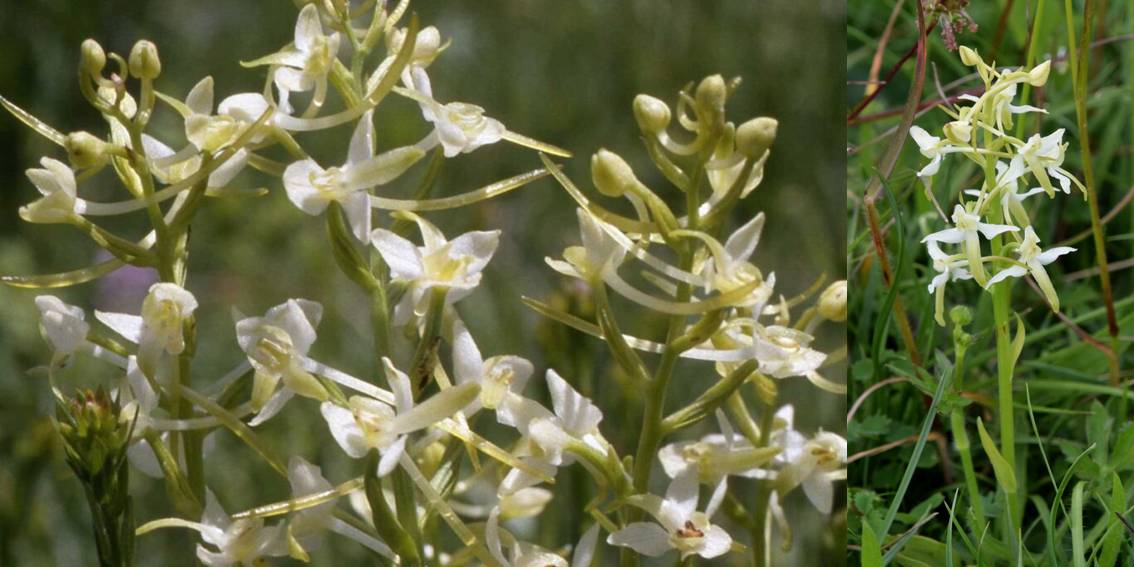
The Lesser Butterfly Orchid: As dusk falls across damp meadows and heath lands, a subtle transformation begins. Among the grasses, a slender spike of pale flowers starts to emit a powerful fragrance. This is the Lesser Butterfly Orchid (Platanthera bifolia) waking up. This delicate plant does not compete with the bold colours of summer flowers. Instead, it reveals its beauty in the twilight, offering a secret spectacle for those who know where to look.
A Study in Elegance
The Lesser Butterfly Orchid presents a picture of understated grace. It typically grows between 15 to 30 cm tall. At the base of the plant, you will find two large, shining green, oval-shaped leaves. These broad leaves give the plant its scientific name, bifolia, which means “two leaves”. From between these leaves rises a slim flower spike. This spike carries a loose cluster of up to 25 delicate flowers. The blooms are a creamy white, often tinged with subtle green. Each flower has a long, slender, straight spur at the back, which holds the precious nectar.
The Hawk-Moth Connection
This orchid relies on a remarkable relationship for its survival. The flowers release their strong, sweet scent only in the evening and at night. This fragrance acts as a beacon, calling out to large moths in the darkness. Hawk-moths, with their long proboscises, are the primary pollinators. The moth hovers in front of the flower, inserts its proboscis into the long spur to drink the nectar. As it does so, the moth’s head brushes against the flower’s reproductive parts. Two club-shaped pollen sacs, called pollinia, stick to the moth’s proboscis. The moth then carries these pollinia to the next flower it visits, ensuring successful pollination.
How to Tell it Apart from its Cousin
You could easily mistake this orchid for its close relative, the Greater Butterfly Orchid. They share a similar appearance and habitat. However, a close inspection of the flower’s centre reveals the difference. In the Lesser Butterfly Orchid, the two pollinia lie parallel and very close together, forming a shape like “II” at the top of the opening. In the Greater Butterfly Orchid, these pollen sacs are spaced widely apart at the base, leaning away from each other to form an inverted “V”. This simple check provides a foolproof method for accurate identification.
A Struggle for Survival
Despite its wide range across Europe and Asia, the Lesser Butterfly Orchid faces significant threats. Its populations have suffered a serious decline, particularly in lowland areas. Modern agricultural practices pose the greatest danger. The drainage of damp fields, the use of fertilizers, and the ploughing of old meadows all destroy its habitat. Even in upland areas, overgrazing by livestock can prevent the plants from flowering and setting seed. This orchid needs open, unimproved grasslands where it can compete with other vegetation.
A Delicate Balance
The future of the Lesser Butterfly Orchid depends on careful land management. It thrives under a regime of light grazing. This keeps more aggressive grasses and heather in check without damaging the orchid’s emerging shoots in spring. The plant also relies on a specific fungus in the soil. This mycorrhizal partner helps the microscopic orchid seeds to germinate and grow. Using fungicides or artificial fertilizers will break this vital link, making the soil uninhabitable for the orchid. Therefore, protecting this species means protecting the entire ancient, low-intensity system it calls home.