A Remarkable Genus of Hardy Plants
The wild Thymelaea Hirsuta, commonly known as sparrow-worts, comprises a fascinating group of plants adapted to diverse environments. They thrive in habitats ranging from the Mediterranean maquis to central Asian plains. These hardy shrubs and herbs are notable for their toxic properties, historical medicinal uses, and remarkable practical applications.
Genus Overview: Thymelaea (Sparrow-worts)
The genus name Thymelaea combines the Greek words θύμος meaning thyme, and ἐλαία (elaía), meaning olive. This name references the plant’s small, thyme-like leaves and fruit that resemble an olive. The English common name “sparrow-wort” derives from the Latin word passer (sparrow), alluding to the perceived similarity between the fruit shape and a sparrow’s beak.
Thymelaea belongs to the family Thymelaeaceae, which also includes Daphne and the commercially valuable ramin (Gonystylus spp.). The genus contains about 30 species of evergreen shrubs and herbs, native to the Canary Islands, the Mediterranean region including Cyprus, central Europe, and central Asia.
Species Spotlight: Thymelaea hirsuta
The wild Thymelaea hirsuta stands out as one of the most remarkable species in the genus. Known by various names including mitnan (Arabic), boalaga (Spanish), bufalaga (Catalan), or shaggy sparrow-wort in English, this xerophytic shrub thrives in harsh desert environments.
Distinguishing Features
The plant grows as a densely-branched, evergreen shrub reaching up to 2 metres in height. Its root system extends to an impressive depth of 3.5 metres, allowing it to access water in arid conditions.
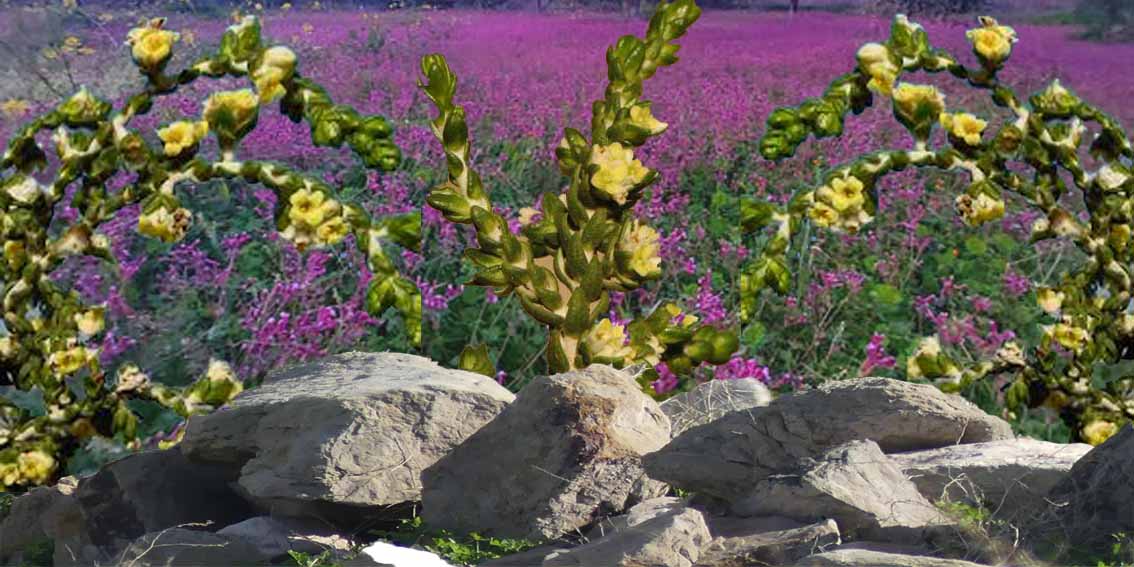
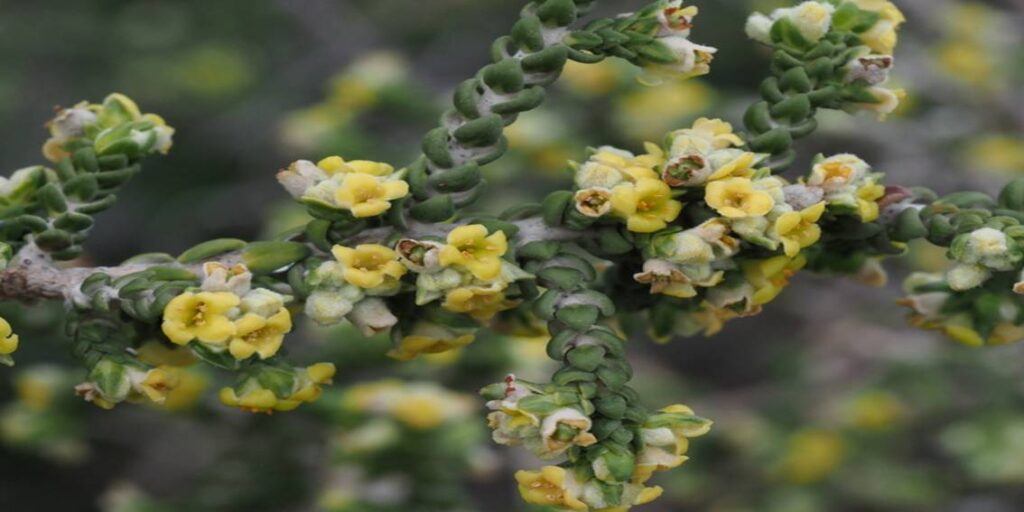
The leaves are tiny (2-6 mm long), scale-like, ovate to oblong, and leathery. They overlap and press tightly against the stem, giving the plant a distinctive textured appearance. The specific name hirsuta refers to the woolly hairs (trichomes) covering the plant.
Thymelaea hirsuta produces clusters of yellow flowers at the ends of young twigs from March to July. The species exhibits complex reproductive biology—it can be dioecious (male and female flowers on separate plants) or sometimes monoecious. The flowers are pollinated by insects (entomogamous). After flowering, the plant produces small fruits consumed by animals, aiding seed dispersal (zoochory).
Distribution and Habitat
This species grows throughout the circum-Mediterranean region, including:
Southern Europe: Coastal regions of Spain, France (including Corsica), Italy, Greece, Cyprus and other Mediterranean countries
North Africa: The Sinai Peninsula and Saharo-Arabian deserts
Middle East: Turkey, the Levant, and desert areas
Toxicity Warning
Like many members of the Thymelaeaceae family, Thymelaea hirsuta contains highly toxic compounds. Scientists have isolated five 12-hydroxy-daphnane diterpenes from the leaves and branches, including gnidicine, gniditrine, and genkwadaphnine . These compounds cause:
Skin irritation: Simple contact with skin or mucous membranes triggers intense inflammatory reactions
Potential carcinogenicity: Some compounds act as potential carcinogenic agents
Animal toxicity: The plant is poisonous to fish, mammals and humans. The plant belongs to the Thymelaeaceae family, which contains toxic species.
Traditional and Contemporary Uses
Despite its toxicity, Thymelaea hirsuta has served human communities for centuries.
Fibre Production
The inner bark (bast fibre) yields exceptionally strong material for rope-making. Bedouin communities still practice this traditional craft, producing cordage strong enough to:
Haul a person from a well
Secure tents during sandstorms
Hobble animals and saddle donkeys
Yoke camels
Carry water vessels on camelback
The simplest method involves braiding whole branches into cables. More refined techniques create flexible, elegant rope from processed inner bark.
Paper-making
Contemporary artisans now appreciate mitnan’s value for handmade paper. The bast fibre produces high-quality sheets when processed correctly. Craftspeople must carefully scrape away dark outer bark to avoid flaws in the final product.
Historical Medicinal Applications
The 13th-century Andalusian physician Ibn al-Baitar documented several medicinal uses:
Leaves: Treatment for pinworms, skin inflammation, and as a powerful hydragogue cathartic and expectorant
Bark: Wound healing applications
Dried, powdered leaves: Treatment for skin inflammation
Contemporary Traditional Medicine
Modern traditional practitioners continue using the plant for various purposes:
Dental care: A leaf decoction serves as a mouthwash to dislodge carious teeth
Eye treatments: Remedies for eye diseases
Paralysis: Treatments for paralysis
Veterinary use: Prevention of miscarriage in camels—practitioner’s pound leaves with salt and apply the poultice to the cervix after impregnation
Scientific analysis has isolated stigmasterol from the plant, a phytosterol that serves as a precursor to progesterone—the hormone used to treat recurrent abortion in humans.
Practical Pest Control
Bedouin communities historically used mitnan to remove flies from tents. They dipped the plant in sugared water and hung it inside. The numerous small leaves and flowers attracted masses of flies. At night, they covered the plant with a cloak and removed both the mitnan and the trapped flies.
Other Notable Thymelaea Species
The genus includes approximately 33 accepted species with diverse characteristics:
Thymelaea passerina (Spurge Flax)
This species differs significantly from T. hirsuta. It grows as an annual herb reaching 0.6 metres tall, with upright stems and linear leaves. Tiny flowers (2-3 mm) appear singly or in pairs in leaf axils. Native to Eurasia, it has naturalized in parts of North America, particularly along roads and railways in the midwestern United States.
Other Mediterranean Species
The genus includes numerous other species distributed across the Mediterranean and Asia, such as:
Thymelaea tartonraira, Thymelaea tinctoria, Thymelaea villosa, Thymelaea hirsuta and Thymelaea passerina
Conservation Status
Thymelaea hirsuta currently faces no major conservation threats . The Royal Botanic Gardens, Kew predicts its extinction risk as “not threatened” based on recent assessments. The Millennium Seed Bank Partnership maintains seed collections of this species, preserving genetic material for future use.
Cultivation Notes
For gardeners interested in growing Thymelaea hirsuta, consider these requirements:
Position: Full sun
Soil: Well-drained soil
Protection: Shelter from winter rain
Suitable for: Rock gardens or alpine houses
Specimens are not currently grown at Kew Gardens, though the Economic Botany Collection holds examples of wood and string made from the plant.
Summary
The genus Thymelaea represents a fascinating group of plants that have evolved remarkable adaptations to challenging environments. Thymelaea hirsuta, in particular, exemplifies the complex relationship between humans and potentially dangerous plants—providing essential materials while demanding respect for its toxic properties. From Bedouin rope-makers to contemporary paper artists, from medieval physicians to modern pharmaceutical researchers, this “shaggy sparrow-wort” continues to reveal its secrets to those who study it carefully.