A Jewel of Rocky Coasts and Mountains
The Blue Rock Thrush (Monticola solitarius) is a stunning bird. It brings a splash of vibrant colour to rugged and inaccessible landscapes. It is about the size of a starling. This species belongs to the Old World flycatcher family. The bird presents dramatic contrasts in both its appearance and its habitat.
Its scientific name, Monticola solitarius, comes from Latin. It beautifully translates to “solitary mountain-dweller.” This name suits the species perfectly. The bird is often seen, yet remains elusive in its behaviour.
Striking Sexual Dimorphism
The male and female Blue Rock Thrush looks so different that they could easily be mistaken for two separate species.
The male is unmistakable in the breeding season. The nominate subspecies (M. s. solitarius), found across its European and North African range, boasts a uniform, deep blue-grey plumage that can appear almost black in poor light . Some sources describe his colour as a “very dark metallic blue,” with wings often appearing darker. Other subspecies, like M. s. philippensis found in Asia, have a striking rufous-chestnut belly and under tail, creating a bold two-tone effect.
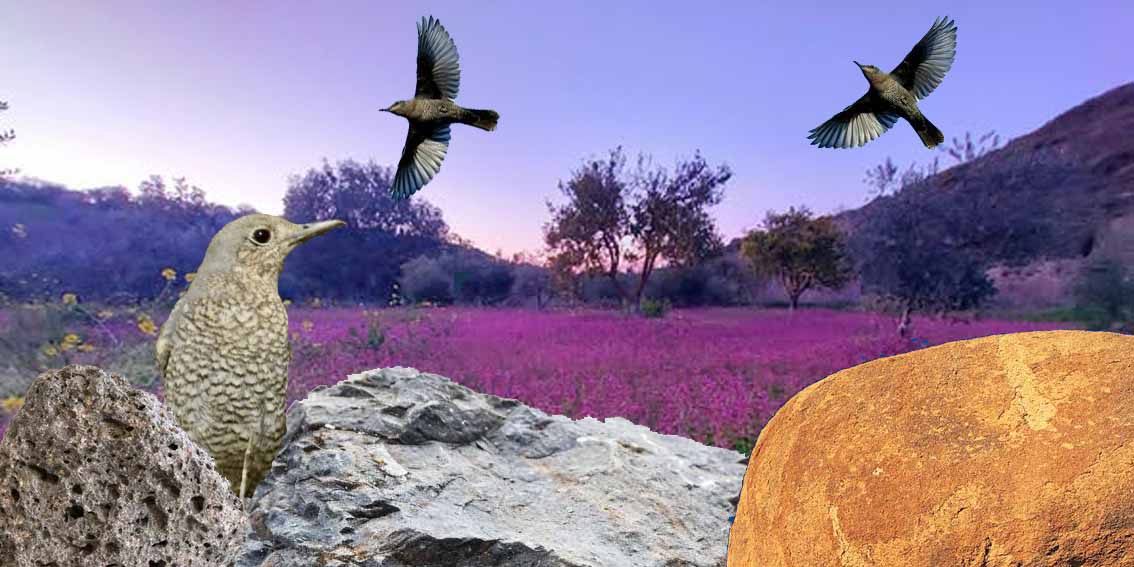
In complete contrast, the female and immature birds are much more subdued. They have dark grey-brown or grey-blue upperparts, with paler under parts heavily marked with dark brown or blackish scales or mottling. This cryptic colouration provides excellent camouflage while they are nesting or foraging on rocky terrain.
Preferred Habitat: From Cliffs to Cathedrals
As its name implies, the Blue Rock Thrush is inextricably linked to rocky environments. Its primary habitats are precipitous sea cliffs, inland gorges, rocky valleys, quarries, and boulder-strewn slopes. They favour sunny, dry, and warm areas, from sea level up to elevations of 4,420 metres.
Remarkably, this bird has also adapted to human-altered landscapes. In parts of southern Europe, it frequently nests on ruins, castles, churches, monuments, and even occupied buildings, effectively treating them as artificial cliffs. This adaptability allows it to thrive in both wilderness and urban environments, as long as vertical structures and open areas for foraging are available.
Diet and Feeding Habits
The Blue Rock Thrush is an omnivore, with a diet that shifts with the seasons. Its primary food source is a wide variety of invertebrates, including beetles, ants, grasshoppers, spiders, and snails. It also preys on small vertebrates like lizards and, occasionally, small reptiles or amphibians.
It typically forages by perching upright on a prominent lookout, such as a rock, rooftop, or dead tree, and then swooping down to catch its prey on the ground. In autumn and winter, when insects become scarce, it supplements its diet with fruits and berries.
Breeding and Behaviour
The Blue Rock Thrush is a mostly solitary or pair-dwelling bird, rarely seen in groups. The breeding season begins in spring, typically from April to July, varying with latitude and altitude. The male establishes his territory and attracts a mate with his powerful, melodious song, often delivered from a high, exposed perch.
The nest is a shallow cup or rough pad constructed from coarse grass, rootlets, moss, and leaves, lined with finer materials. The female builds this nest in a well-hidden crevice, under a rock overhang, inside a cave, or within a hole in a building, usually 2-5 metres above ground. She lays a clutch of 3-6 eggs, which she incubates for about two weeks. Both parents share the duty of feeding the chicks, which fledge approximately 14-18 days after hatching.
Distribution, Migration, and Cultural Significance
This species has an extremely large range, breeding across southern Europe, northwest Africa, and through central Asia to northern China and Malaysia. Populations in southern Europe, North Africa, and Southeast Asia are generally resident. However, those breeding in central Asia and northern parts of its range are migratory, wintering in sub-Saharan Africa, India, and Southeast Asia.
The Blue Rock Thrush holds a special place in human culture. It is the national bird of Malta, where it is known as the Merill and was once featured on the country’s Lm 1 coins. In Japan, it is the official bird of Nagasaki Prefecture and the city of Suzuka . In parts of Spain, it is locally known simply as “loners” (solitarios), a nod to its solitary habits. Its Greek name is γαλαζοκότσυφας (galazokótsyfas).
Conservation Status
Globally, the Blue Rock Thrush is classified as Least Concern on the IUCN Red List. It has an extremely large range and a large, stable global population estimated at 1.3 to 3 million mature individuals. While it faces localised threats from coastal development, disturbance, and persecution in areas like Malta, its overall population is not considered to be at significant risk.