This Spring Visitor Heralds the New Year
The Great Spotted Cuckoo this is bird with a loud, chattering call rings out across the Cypriot countryside. A large bird with a distinctive crest glides low and fast between the scrubs, its long tail trailing behind it. This is the Great Spotted Cuckoo (Clamator glandarius), known to Greek Cypriots as Κισσόκουκος (Kissokoukos). In some areas, locals call it Kalochronia, meaning “good years,” because it arrives as early as January or February, bringing the first sign of the approaching spring.
A Striking Appearance
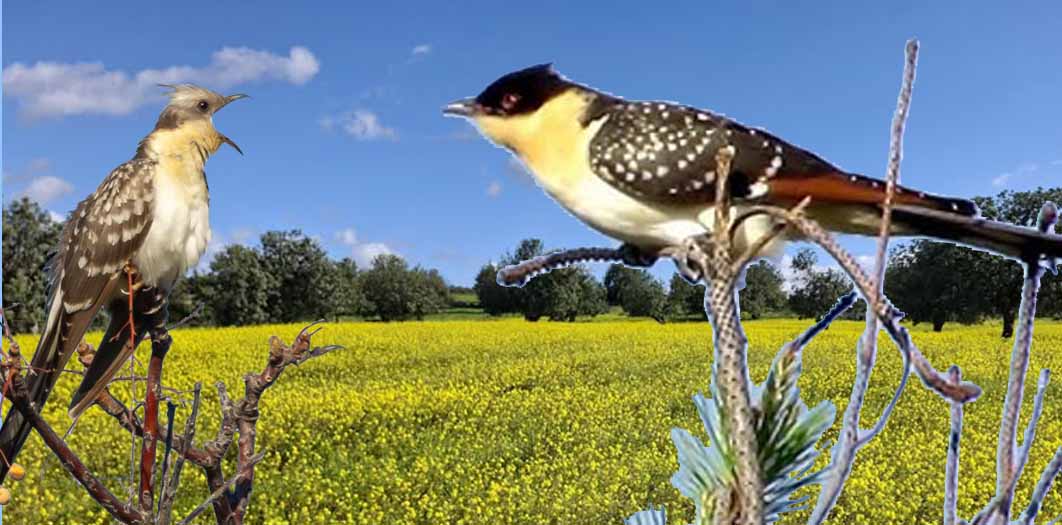
The Great Spotted Cuckoo cuts an unmistakable figure. It is a crow-sized bird, measuring 35 to 39 centimetres in length with a wingspan of 58 to 60 centimetres. A prominent silvery-grey crest adorns its head, which it can raise or lower depending on its mood. The upperparts appear dark grey-brown with bold white spots on the feathers, creating a speckled effect. The under parts show a creamy-yellow or buff colour, with a pale grey throat. The long tail features broad white tips, visible in flight. Males and females look similar, though males weigh slightly more at around 170 grams compared to the female’s 140 grams.
A Master of Deception
Like its relative the Common Cuckoo, the Great Spotted Cuckoo practices brood parasitism. It lays its eggs in the nests of other birds, tricking them into raising its young. In Cyprus, it specializes in parasitizing the nests of Magpies and, to a lesser extent, Hooded Crows. The strategy involves teamwork. The male often distracts the host pair while the female swoops in. She quickly visits the nest, sometimes destroys one of the existing eggs, and lays her own in its place. The female may lay between 12 and 25 eggs in a single breeding season, spreading them among different host nests.
The Cuckoo Chick’s Advantage
The cuckoo chick hatches earlier than the host’s own young. Great Spotted Cuckoo eggs incubate in about 12 to 15 days, slightly shorter than the incubation period of magpies or crows. This head start gives the cuckoo chick a significant advantage. It grows faster and begs more loudly for food, receiving a larger share from its unsuspecting foster parents. Unlike the Common Cuckoo chick, the Great Spotted Cuckoo chick does not push the host’s eggs or chicks from the nest. Instead, it grows up alongside them, competing for food but not eliminating its nestmates.
Habitat and Diet
The Great Spotted Cuckoo favours dry, open areas with scattered bushes and trees. In Cyprus, it lives in farmland, scrubland, and areas with olive groves or low vegetation. It avoids mountainous and densely forested regions. The bird often hops on the ground or flies low and fast with its tail raised.
Its diet consists mainly of large, hairy caterpillars, which many other birds find unpalatable. The cuckoo skilfully removes the hairs by beating the caterpillar against the ground or a branch before swallowing . It also eats other insects such as locusts, beetles, termites, grasshoppers, moths, and occasionally small lizards.
Voice and Behaviour
The Great Spotted Cuckoo is quite noisy. It produces a loud, rapid, chattering call that resembles “krikrikri” or a turn-like rattle. Another common call sounds like a harsh, repeated “shree-chuck”. This vocal nature often gives the bird’s presence away before a person sees it. It usually appears singly or in pairs, perching on exposed branches or low mounds.
Migration and Status in Cyprus
The Great Spotted Cuckoo visits Cyprus as a spring migrant and breeding visitor. It arrives remarkably early, with some individuals appearing in January, though February and March see the main influx. This early arrival explains its Cypriot name Kalochronia, as it coincides with the start of the New Year. Adult birds depart for their wintering grounds in Africa during July. The juveniles, raised in Cypriot nests, follow later, leaving between early July and November.
Conservation Status
Globally, the Great Spotted Cuckoo holds a conservation status of Least Concern. Its European breeding population numbers between 77,000 and 150,000 pairs, with Spain and Turkey hosting the largest numbers. The population appears stable or increasing across most of its range. In Cyprus, it remains a regular and characteristic visitor to the countryside, delighting those who spot its distinctive form or hear its chattering call.
A Unique Cypriot Connection
The Great Spotted Cuckoo shares a close relationship with Cyprus’s Magpie population. Wherever Magpies thrive, these cuckoos are never far behind. This dependence shapes the cuckoo’s distribution across the island. It concentrates in areas where its hosts nest, particularly in open farmland and scrub with scattered trees. Birdwatchers can spot it across the island, including at Akrotiri Gravel Pits and in the Akamas peninsula .
Spotting the Great Spotted Cuckoo
For those wishing to see this fascinating bird, timing matters. Late winter and early spring offer the best chance, from February through May. Look in open areas with scattered bushes, olive groves, or farmland, especially near magpie territories. Listen for its distinctive chattering call, and watch for a large, long-tailed bird flying low over the scrub or hopping on the ground. With patience and a little luck, the Kalochronia will reveal itself, bringing its message of good years to another Cypriot spring.