From YouTube Prankster to Political Phenomenon
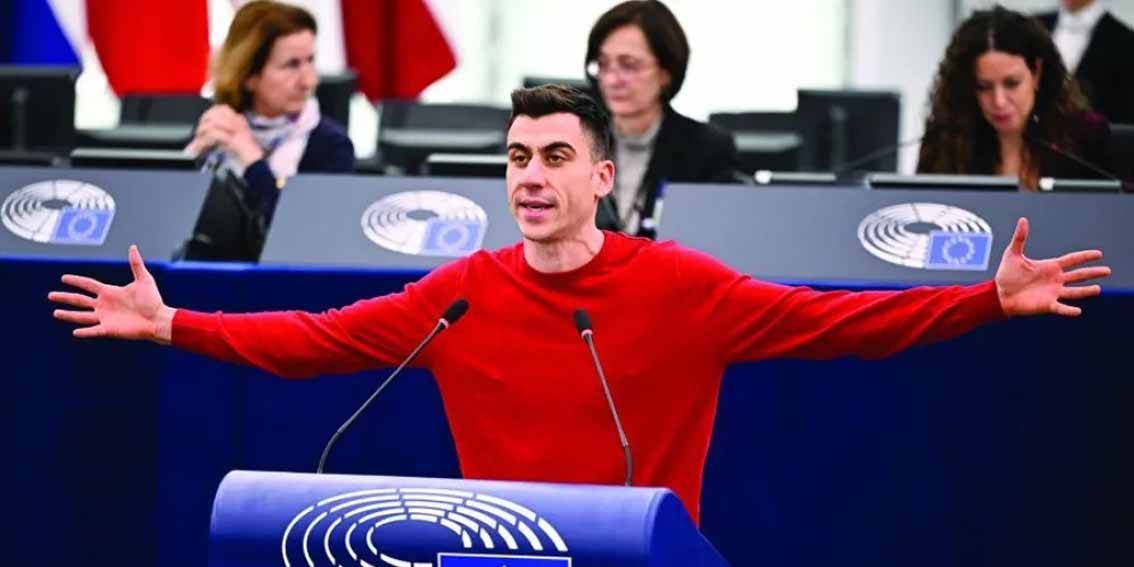
Fidias Panayiotou MEP began his career creating outrageous challenge videos on YouTube. Fidias gained fame through several stunts. He camped outside Twitter headquarters for 69 days. His goal was to hug Elon Musk. Also survived in an airport for a week with no money. His channel now boasts over 2.6 million subscribers. In June 2024, he won a seat in the European Parliament. At the time he was 24 years old and he had no political experience. As an independent candidate he captured 19.4% of the Cypriot vote and became Cyprus’s first-ever independent MEP.
The Direct Democracy Experiment
Fidias champions a new model of politics rooted in direct citizen participation. Panayiotou launched the Agora app, through which Cypriot citizens directly decide many of his votes in the European Parliament. He argues that social media enables a return to the dynamics of ancient Athenian democracy, creating a “modern-day agora” where citizens actively shape political decisions rather than merely voting once every five years. Also he founded the Direct Democracy Cyprus party in October 2025 to bring this model to the national parliament.
Controversies and Investigations
Fidias’s political career attracts constant scrutiny. The European Public Prosecutor’s Office is investigating him for potential misuse of EU funds after complaints that he used parliamentary money to rent a luxury Limassol villa he uses as a personal residence. His Agora app faces investigation from Cyprus’s Commissioner for Personal Data Protection over concerns about how it processes personal data and political opinions. He travelled to Moscow for Russia’s Victory Day celebrations in May 2025, presenting it as a “peace mission” while critics labelled him an “asset to Russia”. He voted against a European Parliament resolution calling for the return of Ukrainian children abducted by Russia.
Questionable Candidate Selection
The selection of Fidias’s parliamentary candidates has sparked intense debate. He appointed three “random friends” to an Executive Council that controls party operations. One candidate, Valerie Tarapai, publicly confirmed she served two years in prison for drug trafficking in the occupied territories. Critics also identified candidates with alleged ties to investor fraud and pornography production. Fidias Panayiotou MEP controls the Agora platform through which candidates emerged, and no independent verification of the voting process exists.
The Parliamentary Elections Loom
Cyprus holds parliamentary elections on May 24, 2026. Direct Democracy Cyprus polls at approximately 6.5%, placing it fifth in a fragmented political landscape where the leading party garners only 17%. Fidias must choose between his MEP seat and a parliamentary seat if elected. If he chooses the Cypriot parliament, the state must hold a special by-election costing €6 million to fill his vacated MEP position, since he won as an independent with no runner-up.
Building a European Alliance
Fidias works to form a new political group in the European Parliament. He needs 23 MEPs from seven countries and reportedly collaborates with Slovak MEPs aligned with Prime Minister Robert Fico, who holds pro-Russian views. He has also approached Greek MEPs Nikos Pappas, Nikos Farantouris, and Nikos Anadiotis, who attended a BRICS summit in Russia. Success would grant him increased speaking time, committee representation, and access to EU funding.
A Divided Public Response
Cypriot public opinion on Fidias remains sharply divided. One recent poll shows 70% of respondents hold a negative impression of him. Yet his supporters remain loyal, and he continues to attract international media attention that far exceeds his parliamentary influence. Political analysts note that his voters rarely examine the controversies beyond his carefully curated social media content. Some dismiss him as a “clown,” while others see him as a necessary disruptor of a stagnant political system.
What His Rise Means for Cyprus
Fidias represents a new form of “post-politics” where content creation replaces policy substance and algorithmic engagement trumps traditional political debate. His success forces Cyprus’s established parties to confront a generation of voters who consume politics through TikTok and YouTube rather than newspapers or television broadcasts. Whether his model represents the future of Cypriot democracy or a passing phenomenon remains uncertain, but his impact on the country’s political landscape is already irreversible.