A Graceful Wader of Freshwater Wetlands
The Wood Sandpiper (Tringa glareola) is a small, elegant wader belonging to the sandpiper family, Scolopacidae. It is a Eurasian species, recognised as the smallest of the shanks—a group of mid-sized, long-legged waders that typically inhabit freshwater environments rather than coastal areas. This bird is known for its delicate appearance, distinctive markings, and lively behaviour.
Identifying Features
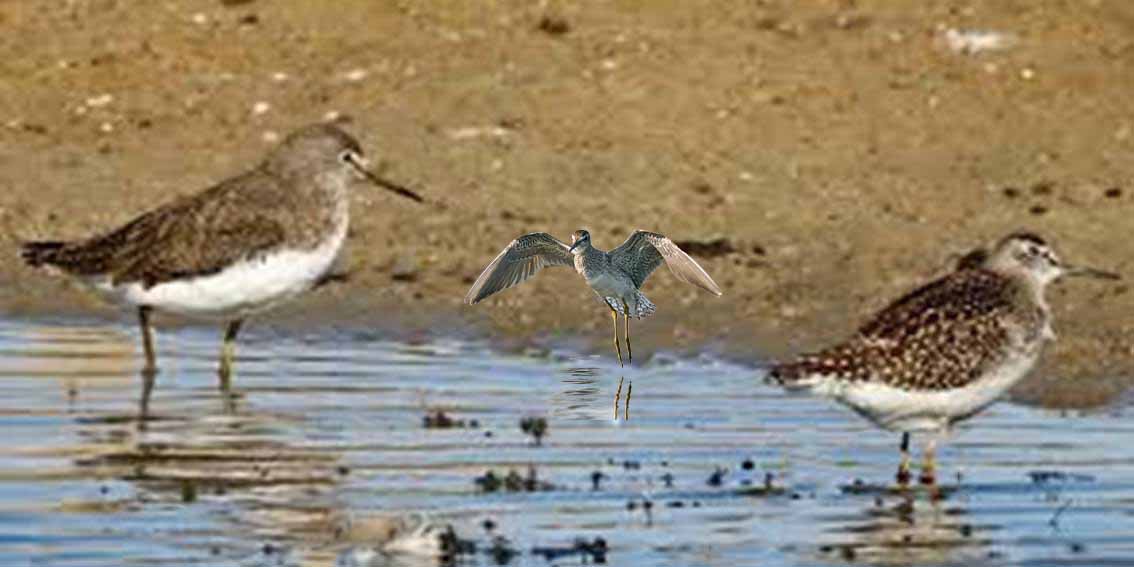
The Wood Sandpiper presents a slim, stylish silhouette with several key features to aid identification. It has a distinct white eyebrow stripe (supercilium) that extends behind the eye, dark grey-brown upperparts with pale spots or flecks, and a white underside. Its breast is lightly mottled with brown. A crucial identifier is its long legs, which vary in colour from yellow to yellow-green. In flight, it reveals a square, white rump patch and shows no wing bars . It is smaller and more delicate than the similar Green Sandpiper, with a longer bill and a less contrasting white rump.
Preferred Habitat
Unlike many of its relatives that frequent coastal mudflats, the Wood Sandpiper shows a strong preference for freshwater wetlands. You will typically find it in small flocks or singly at the edges of inland shallow ponds, lakes, marshes, and flooded grasslands. It favours locations with emergent reeds, grass, and surrounding vegetation, often including fallen timber or scattered trees. This preference for wooded wetlands gives the bird its common name.
Vast Distribution and Migratory Journey
The Wood Sandpiper holds an extremely large global range, estimated at 23 million km². It breeds in subarctic and temperate wetlands across northern Europe and Asia, from the Scottish Highlands and Scandinavia through Russia to eastern Siberia. It is a long-distance migrant. After breeding, most populations undertake a remarkable journey to winter in tropical Africa, South Asia, Southeast Asia, and Australia. A small resident breeding population also exists in Scotland, established since the 1950s. They are passage migrants in countries like Ireland and Greece, passing through on their way to and from wintering grounds.
Diet and Feeding Behaviour
The Wood Sandpiper feeds mainly on aquatic insects and their larvae, as well as molluscs, crustaceans, and various worms. It forages by wading daintily through shallow water, probing its bill into mud or picking prey from the surface. It also swims well and may feed by sweeping its bill from side to side under water. The bird is wary and nervous; if disturbed, it will burst into flight, zig-zagging away while calling loudly, before gliding back to the ground.
Breeding Biology
The Wood Sandpiper breeds in a variety of northern habitats, including open forests, marshes, bogs, and tundra. It typically nests on the ground in a shallow depression lined with grass and leaves . Interestingly, it will also readily use the old tree nests of other bird species, such as the Fieldfare. The female lays a clutch of four pale green eggs between March and May. Both parents incubate the eggs for about 22-23 days, and the young birds fledge after approximately 30 days. The male performs a distinctive switchback display flight during the breeding season, accompanied by short trilling calls.
Voice and Calls
The Wood Sandpiper’s call is a characteristic and useful identification tool. It gives a loud, shrill, whistled “chiff-iff-iff” or “chiff-chiff-chiff” in flight, which is distinctly different from the calls of other sandpipers. Its alarm call is a sharper “chip” repeated rapidly.
Conservation Status
The Wood Sandpiper has an extremely large range and a very large global population, estimated at 3-4.6 million mature individuals. Its population is not believed to be decreasing rapidly, and therefore the IUCN Red List classifies it as Least Concern. It is one of the species protected under the Agreement on the Conservation of African-Eurasian Migratory Water birds (AEWA). While the global outlook is positive, localised threats include wetland destruction and pollution along its migratory flyways. In Ireland, where it is a scarce but regular passage migrant, it is assigned an Amber conservation status due to its small local population.