A Unique Cypriot Resident
The Black Francolin, known locally as the ‘Francolina’, holds a special place in the wildlife of Cyprus. It is a resident breeding bird and, remarkably, the only European country where you can find this species in the wild. This gamebird, a member of the pheasant family Phasianidae, is a shy and secretive creature, more often heard than seen as it skulks through low vegetation.
Striking Sexual Dimorphism
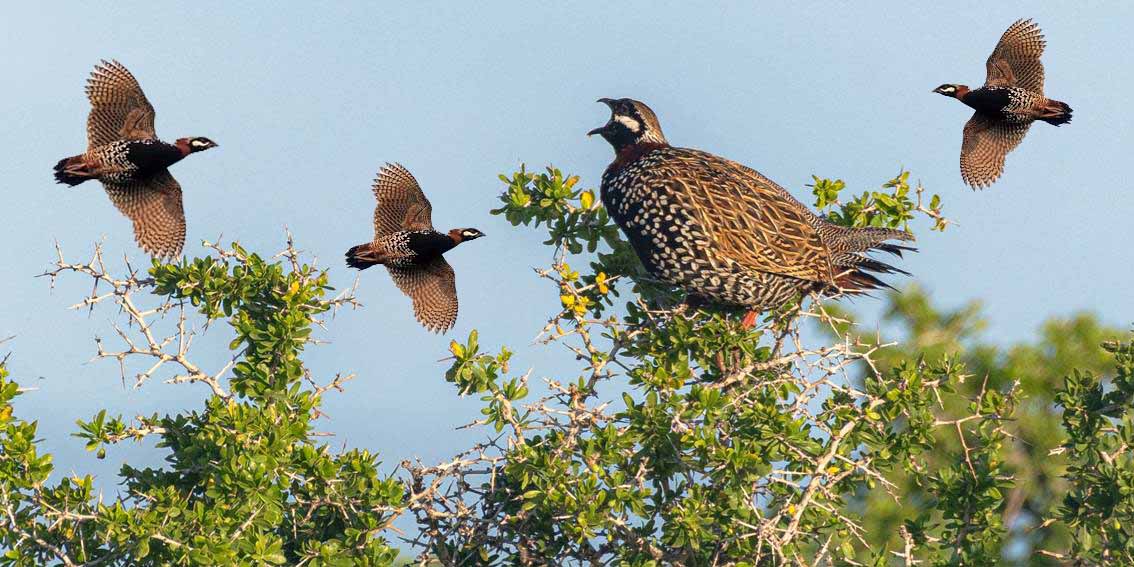
The male Francolina is an exceptionally handsome bird with a plumage of dramatic contrasts. He appears mainly black, with heavy white spotting on his flanks and back. A rich chestnut-brown collar adorns his neck, and he has bold white patches on his cheeks. His legs are a vibrant red. In complete contrast, the female has a much more subdued appearance. Her plumage is predominantly brown with thin yellowish streaks and spots, allowing her to blend seamlessly into her surroundings while nesting . This clear difference in colour between the sexes is unique among the native birds of Cyprus.
Preferred Habitat and Diet
You will find the Francolina in a variety of lowland and semi-mountainous habitats across the island. It favours scrubby areas, coastal valleys, river valleys, and cultivated fields, typically up to an altitude of 700 metres. Large populations exist on the Karpasia Peninsula, in the Paphos district, and near Morphou and Paralimni. As an omnivorous and generalist feeder, its diet reflects its surroundings. Scientific analysis of their stomach contents shows they eat a wide variety of plant matter and insects, with a particular preference for seeds of cultivated crops and beetles (Coleoptera) and ants/wasps (Hymenoptera).
Breeding Behaviour
During the spring mating season, the male Francolina becomes highly vocal. He climbs to a high point like a mound or rock and delivers a loud, distinctive, and mechanical-sounding call to attract females. This call, often described as a grating kik-kik-kik or kwee-kweeeee-kwee, carries for a great distance and helps birdwatchers locate this otherwise elusive bird. The species forms monogamous pairs, and the female builds a simple nest—a bare scrape on the ground hidden in dense bushes. She lays up to 12 eggs and incubates them for about 22 days.
A Bird with History
The Francolina’s presence in Cyprus has a long and fascinating history. While it is a native species to the island, some evidence suggests the Romans may have introduced it. Its desirability as a gamebird and food source extended far beyond Cyprus. Historical and DNA research indicates that people transported the Black Francolin from Cyprus to Europe during the Crusades. European nobility, particularly in Italy and Spain, prized it as a delicacy and a symbol of prestige, with strict hunting laws reserving it for the elite. This rich history makes the Francolina not just an endemic treasure of Cyprus, but a bird with a story connecting the island to the royal courts of medieval Europe.