
The Historical Setting
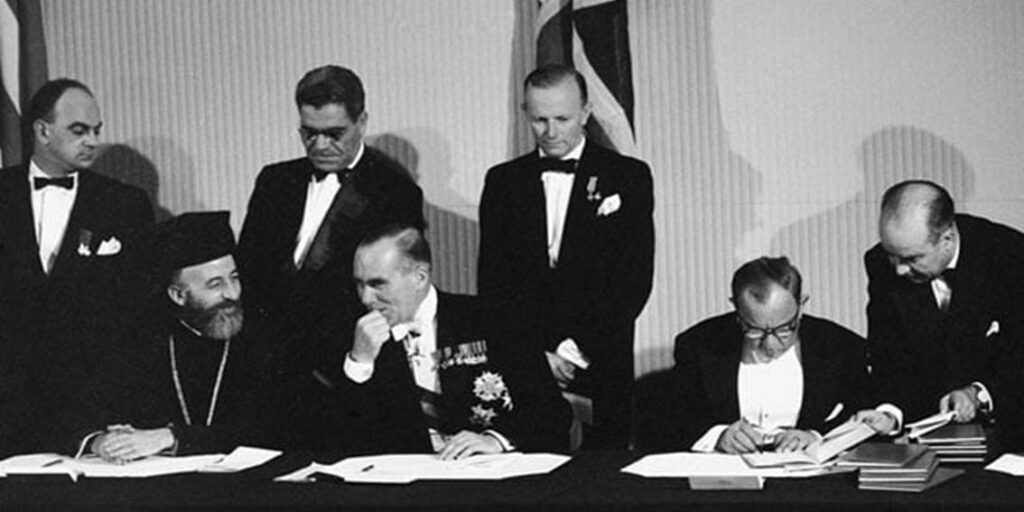
The Zurich Agreements: In 1959, Britain, Turkey, and Greece signed the Zurich-London Agreements. These agreements defined the structure of the independent Republic of Cyprus. The three guarantor powers signed the texts as the underwriters of the new order. The agreement aimed to end the violence between Greek Cypriots and Turkish Cypriots and to prevent the union of Cyprus with Greece.
The Key Points of The Zurich Agreements
The agreement established a state with two communal communities. The constitution imposed a political distinction between Greek Cypriots and Turkish Cypriots. It granted the Turkish Cypriot population veto powers in critical areas. The Turkish Cypriots received the position of Vice-President, with the right to veto laws and decisions of the Ministerial Council. The ratio in the government and public service was thirty to seventy in favor of the Greek Cypriots.
The constitution established separate municipal authorities and divided the Supreme Court into two sections. Greece and Turkey retained the right to station troops on the island. The Treaty of Guarantee gave the three powers the right to intervene to restore the constitutional order.
The Immediate Consequences
The new constitution immediately created enormous difficulties for the functioning of the state. Continuous vetoes and a lack of cooperation paralyzed the parliament and the executive authority. Political life constantly revolved around communal issues. Tension quickly escalated into intercommunal clashes.
Just three years later, in 1963, the crisis peaked. Greek Cypriot leaders proposed thirteen amendments to change the constitution. The Turkish Cypriot side rejected them categorically. Violence broke out in December 1963, leading to the collapse of the common republic. The Turkish Cypriot ministers withdrew from the government.
A Divided Legacy
The Zurich Agreements failed to create a viable state. Instead of promoting unity, they institutionalized division. The structure they imposed proved unworkable in practice. The collapse of the institutions led directly to further conflict and, ultimately, to the Turkish invasion of 1974.
The agreement remains a historical reference point. It still shapes the political realities on the island. The Greek Cypriot and Turkish Cypriot narratives offer completely opposing interpretations of its intentions and failure. Its legacy is the model of two separate communities living under a constitutional framework that encourages partition instead of unity.
The Turkish Cypriot Response to the Zurich Agreements
Initial Acceptance as a Guarantee
The Turkish Cypriots initially accepted the Zurich Agreements with a sense of relief. They viewed the agreements as a necessary plan for self-protection. The agreements granted them specific political rights and a constitutional role that exceeded their demographic size. The cover of the Treaty of Guarantee and the presence of Turkish troops in Cyprus gave them vital security against the potential union (Enosis) with Greece. Their leadership estimated that this framework would guarantee their existence as an equal community.
A Practical Deficiency
In practice, the veto mechanism and social division soon created problems. The constitutional system gave the Turkish Cypriot leadership the ability to block decisions, but it simultaneously prevented any form of functional cooperation. The need to continuously use the veto to protect their interests limited the state’s function and reinforced a climate of hostility. Many ordinary Turkish Cypriots faced economic difficulties and social isolation.
The Drastic Shift in Their Stance
After the dramatic events of 1963-64, the initial Turkish Cypriot acceptance of The Zurich Agreements changed radically. The violence, the collapse of the common government, and their entrapment in enclaves made the constitution de facto void. Now, the Turkish Cypriots insisted on the strict and faithful implementation of the Zurich Agreements. This notion became their central official discourse. Their demand for a return to the Zurich constitutional framework actually signified recognition that the structure of the republic had already collapsed.
Towards Secession
The failure of every dialogue for amendment or revision of the agreements led the Turkish Cypriots to a new strategy. From the 1970s onwards, their interpretation of the Zurich Agreements evolved. They now argued that the original framework de facto permitted partition (Taksim). They considered that the existence of two separate communities with separate administrations under the auspices of the Zurich Agreements legitimized the creation of separate political entities.
In Conclusion
The Turkish Cypriots never treated the Zurich Agreements as a simple constitutional text. The agreements represented a guarantee of existence and security for their community. The evolution of their stance—from acceptance, to insistence on their implementation, and finally to their interpretation as a path toward partition—faithfully follows the course of their own political fate on the island.
A Strategic Blueprint for Partition
Turkish Cypriot leaders saw the Zurich-London Agreements not as a final settlement, but as a provisional step. A TMT document discovered in the office of Agriculture Minister Fazıl Plumer after his withdrawal in December 1963 revealed this strategy. The text stated they accepted the agreements precisely because they were a “temporary station,” which gave them two key advantages: the international recognition of Turkey’s rights in Cyprus, and a secured timeframe to prepare for their ultimate goal of “complete freedom.” The document claimed this understanding had direct support from Turkish President Gursel.
The Explicit Rejection of Cooperation
The TMT document expressed a deep-seated opposition to meaningful collaboration with Greek Cypriots. It framed any acceptance of Zurich as a final solution as a path leading to the “annihilation of the Turkish Cypriots.” The text argued that “Cypriotization” – defined as close cooperation and unity – would mean the eternal subjugation of their community. Therefore, they concluded that accepting the agreements as permanent would be an act of self-destruction. Crucially, the document stated that before the signing, the Turkish Cypriot leadership had secured a promise from Ankara for maximum “economic and other assistance” to achieve their “final goal.”
A Detailed Plan for Secession
The planning went beyond rhetoric to concrete action. On September 14, 1963, Turkish Cypriot leader Fazıl Küçük and Rauf Denktaş of the TMT signed a detailed action plan for imposing partition. This document outlined a step-by-step process:
The Turkish Cypriot Vice-President would declare himself the community’s President, forming a separate government.
Turkey would immediately recognize this new government and receive a request for help from it.
This request would justify Turkish intervention. The plan even included issuing Turkish passports to Turkish Cypriots in Turkey to facilitate their transfer to Cyprus.
Turkish Cypriot parliamentarians would form a separate legislative body.
This new entity would sign economic and aid agreements with Turkey.
The document explicitly anticipated a violent Greek Cypriot reaction, predicting an “intercommunal struggle” that would decide the outcome.
It called for the Turkish Cypriot population to forcibly concentrate in a defensible area chosen by military strategists.
Public servants were to be transferred to new roles to ensure the administration’s functionality.
The Ideology of a Separate State
The TMT document also promoted a long-term ideological campaign. It called for instilling in every Turkish Cypriot, from a young age, the conviction that their community was a “separate state.” It stated that organizers needed a clear national plan to guide their words and actions, with the ultimate vision being the day “Turkism dominates Cyprus.”
The Fulfillment of the Plan
The 1963 action plan largely became reality. Article 3, which called for Turkish intervention and the transfer of populations from Turkey, was implemented during the 1974 invasion. The earlier steps—the withdrawal of Turkish Cypriot officials from the state in 1963 and the subsequent formation of a separate administration recognized by Ankara—directly followed the blueprint. This evidence challenges the narrative that the Turkish Cypriot leadership sought to preserve the unified Republic of Cyprus. Instead, it shows a consistent preparation for the events of 1963 and 1974, with the Republic viewed as a temporary platform from which to pursue partition, backed by Ankara.