A Hidden Grave in the Woods
The Secret Cemetery hidden deep in the forests of Cyprus, on a remote slope of the Troodos Mountains, lies a small, forgotten cemetery. The Kyperounta Sanatorium Tuberculosis Cemetery stands as a silent testament to a dark chapter in Cypriot history—when fear and stigma condemned tuberculosis patients to isolation even in death.
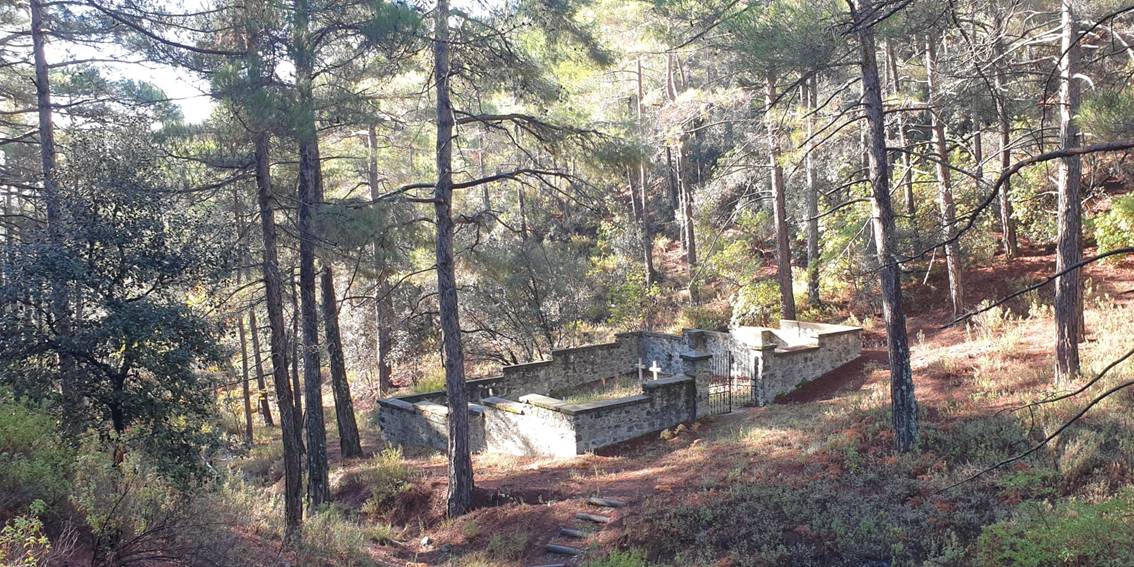
The cemetery remains hidden from view. No road signs mark the way. Visitors must descend one hundred stone steps, installed years later by the Lions Club, to reach the small enclosure hidden among the trees.
Why Did the Cemetery Remain Secret?
The secret cemetery came into existence not by choice, but by rejection. When tuberculosis patients died at the Kyperounta Sanatorium between the 1940s and early 1960s, no one would take their bodies.
Villagers from Kyperounta and nearby Amiantos refused to allow tuberculosis patients to rest in their community cemeteries. They feared the disease would spread even through the dead. Worse still, relatives of the deceased also refused to accept the bodies, fearing social stigmatization would fall upon their families.
So great was the fear that local women, when passing near the Sanatorium road, would turn their backs and cover their noses with handkerchiefs.
A Cemetery Built by the British
In 1943, the British colonial authorities stepped in to solve the crisis. They constructed a dedicated cemetery on a secret slope of Troodos, sized at approximately 100 square meters.
The British allocated 100 pounds for the construction. Burials took place in the presence of only a priest, a nurse, and two gardeners from the Sanatorium, who dug and sealed the graves.
How Many Rest Here?
No one knows the exact number. Six marble crosses now mark the cemetery, but these represent only a fraction of those buried here.
Veteran nurses and Sanatorium staff recount that at least thirty, perhaps as many as fifty, individuals rest in this hidden ground. Wooden crosses, crafted by the priest for each burial, have long since decayed and disappeared.
No official records survive to solve the mystery.
The Stories Behind the Crosses
The marble crosses preserve only fragments of the lives lost:
Name Age Death Date
Titos 3 years old August 14, 1947
Christina S. Koutis 4 years old August 18, 1948
Theodora Hierodiakou 22 years old March 8, 1948
Andreas I. Karakoulas 27 years old May 17, 1948
Sozos Socrates of Dean 29 years old August 12, 1955
One broken cross reveals only the age 70, its owner’s name lost forever.
The Youngest Patient: Titos
Titos died at just three years old. His parents left him at the Sanatorium and requested that the cemetery bury him under a pseudonym, without a surname. They did not want their family name associated with tuberculosis on a grave marker.
Theodora Who Never Spoke Again
Theodora Hierodiakou entered the Sanatorium and never spoke a single word from that moment until her death weeks later.
The Kyperounta Sanatorium
The Sanatorium itself opened in 1940 as the Jubilee Sanatorium, later renamed Kyperounta Sanatorium. With 100 beds, it became the largest and most organized tuberculosis treatment centre in Cyprus.
The location in Kyperounta offered ideal conditions for recovery: low humidity, protection from north-westerly winds, and abundant sunshine. The design drew inspiration from similar sanatoriums in Germany and Finland.
Patients received free medical treatment, yet society still shunned them.
A Long Neglect
The cemetery fell into abandonment after the early 1960s. No burials occurred there after that time. For decades, it remained forgotten, overgrown, and hidden from public knowledge.
Dr. Michalis Voniatis, an epidemiologist who served as Director of the hospital from 1977 to 1980, first learned of the cemetery from an elderly nurse who showed him the location before he left his post.
Recent Rediscovery and Remembrance
In 2017, a renovation project restored the cemetery. The Lions Club, in collaboration with the Department of Forestry, created the stone pathway with one hundred steps leading to the site.
For the first time, the cemetery gained public attention in 2021, when MP Costas Costas and Dr. Voniatis organized a memorial service—73 years after the first burials.
Today, a memorial service takes place annually on March 24, World Tuberculosis Day, to honour those who suffered in silence and isolation.
A Lasting Legacy
Speaking at a 2025 memorial service, Health Minister Michalis Damianos stated: “Today we are not only honouring those who did not manage to defeat tuberculosis. We honour human dignity. The need of our society not to forget. Not to allow stigmatization.”
The cemetery now stands as a reminder of the cruelty of stigma—and the enduring need for compassion.