A Unique Bird of Cyprus’s Natural Heritage.
The Black Francolin is Secretive Bird that hides in the Fields but Announces Itself with a Distinctive Call. The Cypriot countryside holds a secret. A handsome, crow-sized bird creeps through the undergrowth, hidden from view. It rarely flies, preferring to keep its feet firmly on the ground. This is the Black Francolin (Francolinus francolinus), a resident breeder and one of the island’s most intriguing game birds. Birdwatchers know it well, though they more often hear it than see it.
A Bird of Two Distinct Populations
The Black Francolin in Cyprus concentrates its numbers in two specific regions. On the Karpasia peninsula in the north-east, a population of about 200 birds makes its home. In the west, the lowlands of Paphos district hold approximately 150 individuals, mainly on the Akamas peninsula and around the villages of Paphos and Polis . These two separate groups represent the entire Cypriot population of this species.
A Striking Appearance
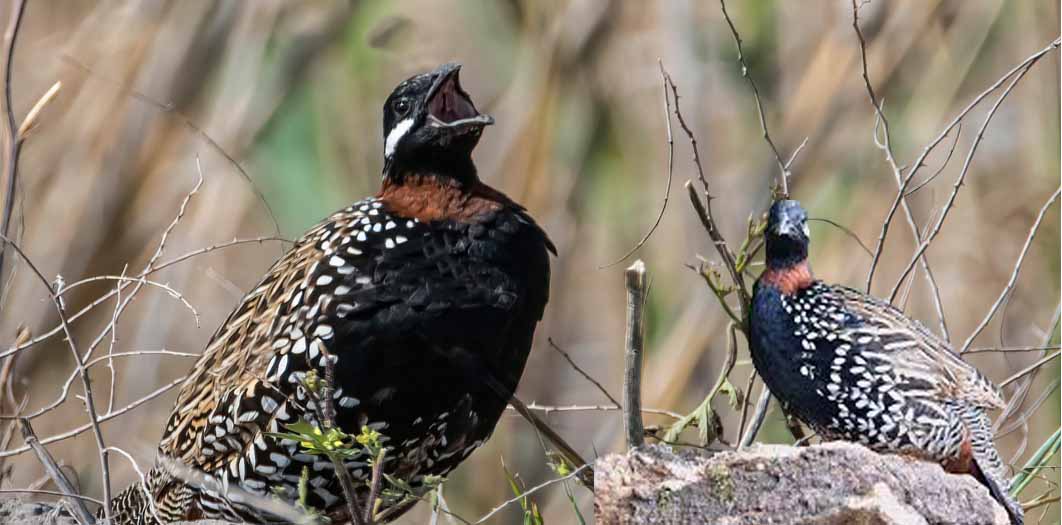
The male Black Francolin cuts a dashing figure. Mostly black plumage covers his body, with white spots adorning his back and flanks. A rich chestnut collar wraps around his neck, and white patches brighten his cheeks. His wings show a warm brown, and his legs stand out as bright red. The female wears more subtle colours, primarily brown with a chestnut hind neck, allowing her to blend seamlessly into her surroundings.
The Voice of Spring
During the breeding season, the male reveals his presence. He perches on a low mound or rock and delivers a mechanical, distinctive call. Birdwatchers describe it as a loud kik-kik-kik, carrying across the fields for a great distance. This call acts as both a territorial warning to other males and an invitation to potential mates. For anyone walking through the Cypriot countryside in spring, this sound provides the first clue that a Black Francolin is near.
Where to Find Them
The Black Francolin favours specific habitats across Cyprus. It lives in dry plains near the coast, wetlands, and cultivated fields. Dense scrub alongside rivers, with plenty of reeds and low cover, provides ideal shelter. The bird stays low to the ground, hidden within the vegetation. It moves up to 20 kilometres inland from the coast, rarely exceeding 400 metres in altitude. Paphos Airport and its surrounding area offers one of the easiest places to observe this species, though the location includes a military base.
Life Cycle and Diet
The Black Francolin nests on the ground. It scrapes a shallow hollow or depression in the earth, sometimes lining it with a few scraps of plant material. Dense vegetation conceals the nest from predators. The female lays between seven and twelve eggs, with the breeding season running from March to May.
The bird feeds on a varied diet. It takes seeds of grasses, weeds and cereal crops, along with shoots, leaves, tubers, berries and figs. Insects also form an important part of its food intake, especially during the breeding season when chicks need protein to grow.
Threats to Survival
Despite its secretive nature, the Black Francolin faces significant pressures. Hunting poses a major threat in both Turkey and Cyprus. A ban on hunting in Cyprus between 1984 and 1985 offered temporary relief, but lobbying by the Hunting Association led to its lifting. The species also suffers from habitat loss. Agricultural intensification removes the diverse vegetation the birds need. In Cyprus specifically, the removal of citrus and tobacco plantations, along with other suitable vegetation cover for tourist developments, destroys prime habitat. The population decline correlates directly with the level of hunting, making protection urgently necessary.
Conservation Efforts
Conservationists recommend several actions to protect this species. Hunting requires strict control, and experts suggest adding the Black Francolin to Appendix II of the Bern Convention. Key areas of suitable habitat need identification and protection from development. Encouraging low-intensity farming practices would restore the diverse landscapes the birds require.
A Unique Genetic Heritage
Recent genetic research has revealed another threat to the Cypriot Black Francolin. Scientists studying the genetic makeup of the population found distinct wild populations in the Nicosia and Paphos districts. These function as separate management units, each with unique genetic characteristics. However, a pet centre in Nicosia imported birds of unknown origin. Genetic analysis showed these birds belonged to alien Asian subspecies, genetically highly divergent from the native Cypriot population. If these foreign birds escape or release into the wild, they could hybridize with the local population and cause extinction through genetic mixing. Researchers advised the Game & Fauna Service to enforce laws banning the import, detention and sale of these foreign subspecies to protect the unique Cypriot Black Francolin.
A Species of Global Concern
The global population of Black Francolin numbers between 300,000 and 840,000 mature individuals. The European population contributes 16,000 to 42,000 of these birds. The species overall holds a conservation status of Least Concern, as it has an extremely large range and a stable population trend globally. However, the Cypriot population, isolated on an island and facing specific threats, requires continued vigilance. Protecting this shy icon of the farmland means preserving not just a bird, but a unique part of Cyprus’s natural heritage.