Heroic Chapter in Nicosia
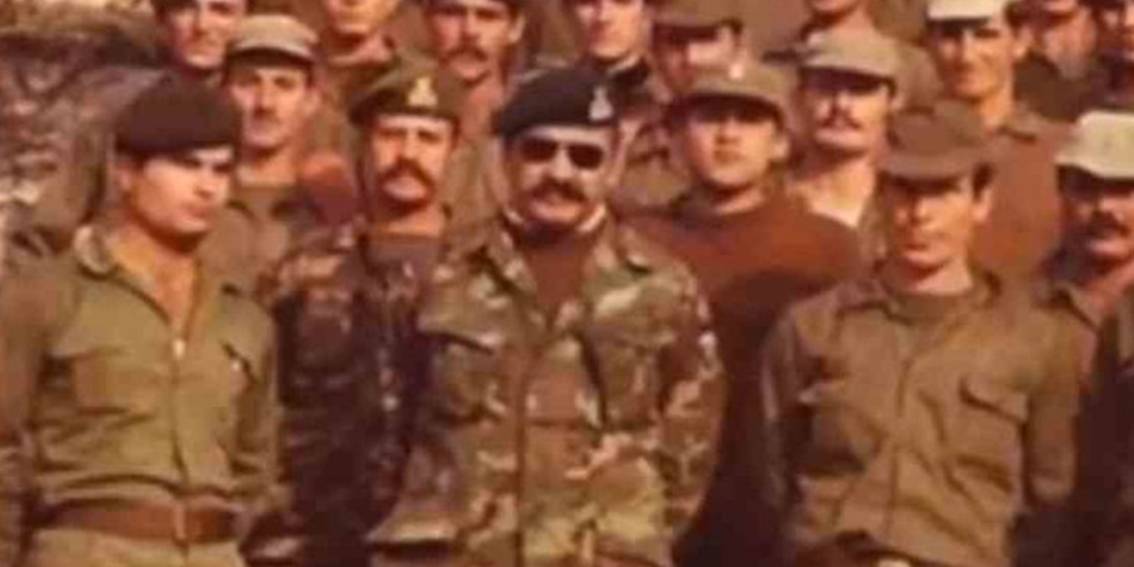
Commando Georgios Papameletiou passed away on March 17. He was the officer who led one of Cyprus’s fiercest battles in 1974.
Papameletiou belonged to a generation of officers with a distinct view of military service. They did not see it merely as a career that offered job security. They saw it as a sacred duty.
“The Turks honoured me before you did,” he once said. His words showed his characteristic bluntness. “They put a bounty on my head.” With this statement, he highlighted how long the Greek state took to recognize his contributions to the homeland.
A Commando’s Path
Papameletiou served as an officer in the Special Forces—a commando, a member of the elite Lochos Oreinon Katadromon (LOK) mountain raiding units. During the Turkish invasion of Cyprus in the brutal summer of 1974, he commanded the First Commando Squadron.
His men remember him as a strict but fair commander. He always pushed his own limits first before demanding the same from his soldiers.
For historians of Modern Greek military history, he remains one of the most emblematic figures. For those who experienced the Turkish invasion firsthand, his name remains inseparable from the legendary “Operation Victory.”
Early Years and Military Career
Commando Georgios Papameletiou was born in 1931 and came of age during a period when Greece’s social and political landscape was marked by hatred, tension, wars, and transformations that seemed almost world-altering.
He graduated from the Hellenic Army Academy in 1954 as an Infantry Second Lieutenant. Early in his career, he showed tremendous interest in the newly established Special Forces of the Greek Army.
The following year, he joined the commando forces. He became one of the first Greek officers to train as a paratrooper.
Those who served alongside him describe an officer with a powerful personality and a deep sense of responsibility.
Over the years, he held various command positions within the Commandos, contributing to the training and development of younger officers.
He retired in 1983 with the rank of brigadier general, concluding nearly three decades of service in the Greek Army.
Yet one event would forever define his legacy: the Turkish invasion of Cyprus in July 1974.
The Invasion and the Birth of Operation Victory
In the summer of 1974, as Greece’s dictatorial regime collapsed in dramatic fashion, the Turks seized the opportunity to invade Cyprus and pursue their long-held goal of dividing the island.
Amid this absolute chaos and with Turkish forces advancing, the Greek side decided to dispatch reinforcements to Cyprus.
This decision gave rise to “Operation Victory,” which historians still regard as one of the boldest and most dramatic military missions in Modern Greek military history.
In the early hours of July 22, 1974, Noratlas transport aircraft took off from Souda Air Base carrying commandos to Nicosia. Their objective: to strengthen the defence of the city’s airport, a strategic location that could prove decisive for the course of operations.
Papameletiou commanded the First Commando Squadron. The flights occurred in darkness, without proper coordination and with limited intelligence about conditions on the ground.
Little went according to plan. The result proved tragic. One aircraft, “Niki 4,” crashed after friendly fire struck it near Nicosia airport—Greek Cypriot anti-aircraft units had not received word that Greek military aircraft were arriving.
Despite the chaos of those first hours, Papameletiou’s commandos organized themselves and reinforced the area’s defences. The fighting around Nicosia airport turned fierce, but ultimately the Turkish forces could not capture it. Many historians consider this outcome decisive for the war’s subsequent course.
Later, Papameletiou’s commandos handed control of the airport over to the United Nations peacekeeping force.
Papameletiou’s Own Account of Operation Victory
For Georgios Papameletiou, those days were not merely a chapter in his military career but a powerful memory that stayed with him until his death.
In an interview, Papameletiou revealed that his unit had not received special training for deployment to Cyprus—their original mission was to defend the Aegean islands.
His description of those events remains striking
The Ambiguous Orders
“Late on July 21, the Commando Commander contacted me and told me we would leave, but not for our intended destination. He spoke to me in vague terms. He didn’t send an encrypted signal or any formal communication—through this phone call, he tried to make me understand that I wasn’t going to the islands but to Cyprus. In the same ambiguous language, he told me not to take much ammunition, not to bring heavy weapons like mortars. He wanted me to understand not to load too much equipment. He was trying to tell me that on July 22 at 10 in the morning, they would sign a truce. That’s why he mentioned ‘tomorrow until 10’… then lucky are those who possess.”
Briefing the Men
Initially, officers received their mission briefing, followed by the commandos. Among the men, Papameletiou noted both concern and excitement.
When the commandos boarded buses to transfer to Souda airport, Papameletiou explained the mission and told them what they needed to keep in mind for those first hours. No one knew what they would face—they had no information about conditions in Cyprus.
The Tragic Arrival
Chaos ensued, culminating in the tragedy of “Victory 4” going down and “Victory 7” taking damage. The pilot managed to land the damaged aircraft, but two commandos died. In those first moments after landing, Papameletiou had no idea what happened to the Noratlas aircraft and certainly did not know where his squadron’s commandos had ended up.
“We didn’t know. Did they not take off? Did they crash? Did they lose their way? I knew nothing. I didn’t even know how many planes there were. I couldn’t understand it—so many planes left Crete and everyone knew about it. The Army General Staff knew, the Hellenic National Defence General Staff knew, everyone knew, and then we come to Cyprus and the anti-aircraft units don’t know and shoot at us from everywhere.”
Gathering His Men and Defending the Airport
After overcoming terrible obstacles and gathering his men, Papameletiou made the obvious decision: defend the airport against Turkish forces that had now advanced to within striking distance.
The Ambush at the Gate
“I boarded the Land Rover they had given me, with the large radio antenna mounted. A Cypriot policeman named Giannakis drove, and my radio operator came along. About 200 meters from the airport gate, I took fire from the left, from where the UN peacekeepers’ quarters used to be.
I immediately ordered the Cypriot driver to stop and shouted, ‘Let’s jump out.’ I jumped first, and the others followed. I am now certain that the bullets came from a small automatic weapon firing 9mm rounds. I believe UN forces fired them from my left, while the Turks, as I later discovered, were on my right. They intended to confuse us—when they saw the Land Rover with the prominent radio antenna, they understood that vehicle carried the commanding officer.
I believe the UN forces intervened at that moment to prevent us from deploying our weapons—machine guns, submachine guns, anti-tank weapons—because the companies had only just arrived at the airport. This helped the Turkish forces in their attempt to seize the airport. Perhaps the UN and the Turks had some mutual understanding, given that their tolerance allowed the Turks to advance toward the airport.
After this burst of gunfire, an exchange began between Turkish forces and our forces inside the airport.”
The Firefight
“The exchange must have started around 11:00. My Cypriot guide Giannakis took a wound in the spine from a ricochet, but his condition was not serious. My messenger Spyros also took a bullet in the shoulder, a minor wound. I took some shrapnel hits, though I didn’t discover that until the next day.
This development surprised me because I had not known the Turks had advanced so close to the airfield. I confess I worried about the fate of the men who had gone ahead.
These events lasted about an hour and a half. Then the United Nations forces stirred from their positions, raised white flags, and ordered a ‘Cease fire.’
A Marksman’s Feat
From the roof where Lieutenant Benos positioned himself, as I later learned, a commando from Patras—an excellent marksman—took position. This commando spotted a group of Turks and with one shot killed 12 as they fled the area.
As subsequent intelligence and intercepted Turkish security service signals revealed, this was a Turkish convoy of 150 soldiers sent to seize the airport before it passed to United Nations control. The convoy also included four tanks positioned toward ELDYK [Greek Forces in Cyprus] to cover their rear. Another tank stood on the hill with an indistinct flag, which we also believed to be Turkish.
The Silence of ELDYK
Not a single rifle fired from the ELDYK camp throughout our exchange with the Turks—not even a warning shot in the air. I later learned they did this to avoid accusations of violating the truce. The Greek Forces in Cyprus command followed UN instructions so faithfully that they failed to act, even when they understood the situation.
I also note that after the ceasefire, Major George Papadopoulos, who held responsibility for the airport’s defence, never came to meet me.”